The best place to debate online depends on what you want from it. For live, face-to-face debates where the audience picks the winner and debaters get paid, use Swevo. For judged, rubric-scored practice rounds, use SuperDebate. For slow, written argument, use Kialo or r/changemyview. If you only want to watch, try Open to Debate or Jubilee.
That is the short answer. The longer one matters, because "debate online" covers a lot of very different experiences. Typing a reply to a stranger at midnight is debating online. So is standing on camera, with a timer running, while a live audience votes on whether you just won the round. Pick the wrong kind of platform and you will either be bored or out of your depth.
Below are seven places worth your time in 2026, what each one is actually like, and who it suits.
Before comparing platforms, answer one question: do you want to watch, practise, or compete?
- Watching means great debates with no pressure. You learn by seeing how strong debaters handle a hostile question.
- Practising means low stakes and lots of repetition. You want feedback more than an audience.
- Competing means real opponents, real stakes, and a real verdict. Ideally, an audience that grows over time.
The second question is pace. Written platforms give you time to research and think. Live platforms test whether you can think on your feet, which is a different skill and, for most people, the one that actually matters in a meeting, an interview, or a family dinner.
Swevo: live debates where the audience decides
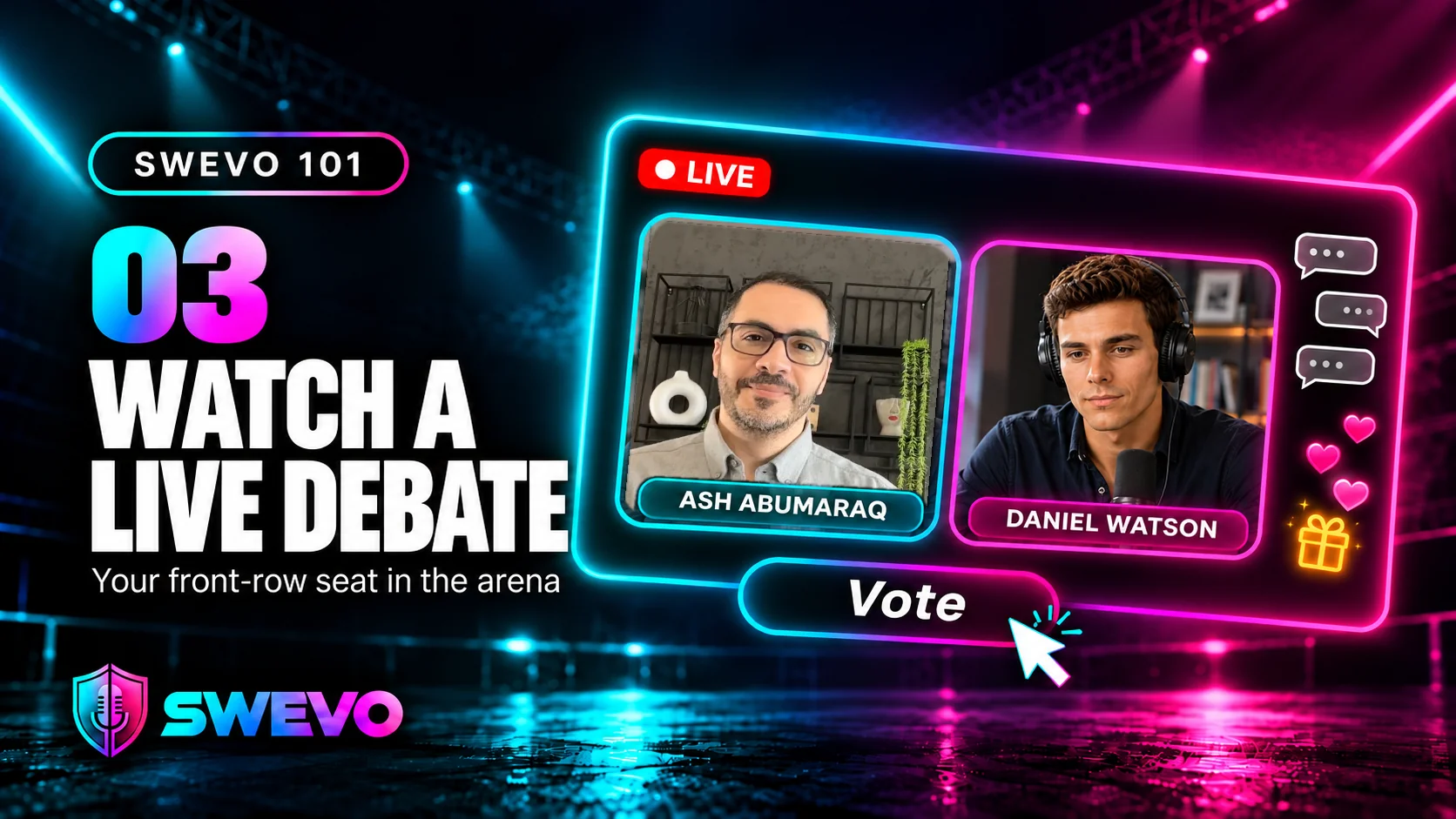
Swevo is a live video debate platform. Two debaters face each other on camera and work through a set of questions. On each question one side opens, the other responds, both get a rebuttal, and then the audience votes. Viewers vote after every question and once more at the end, and those votes decide the winner. There are no judges. The audience owns the verdict.
What makes it different is that the crowd is part of the debate rather than spectating it. Viewers chat, ask questions, and back the debater they think is winning with gifts. Debaters keep 65% of every tip and gift, and earnings are paid out once your balance passes $100. Anyone can start: post an open challenge or call out a specific opponent. You need a camera and a decent connection, not a debate background. Watching is free and does not even need an account.
Best for: people who want to debate live, build an audience, and earn from it.
SuperDebate: judged rounds and a debate league
SuperDebate runs structured debates with assigned sides and equal time: opening, cross-examination, rebuttal, and closing. Online events use live video rooms, with formats from one-on-one up to five-on-five. Judges score debaters on a published six-part rubric (arguments, refutation, evidence, clarity, organization and persuasion), and audience voting is available too. It also runs local clubs and ticketed live showcases in cities like Chicago and New York, and it is free to start.
It is genuinely good at what it sets out to do, which is rigorous, coached practice. Its own line describes it as running a league. The trade-off is that it is built around scheduled events and judges' scorecards, and we found no way for debaters to earn there.
Best for: people who want structured, judged practice and detailed feedback.
Kialo: debate as a written argument map
Kialo, which calls itself the world's largest argument mapping and debate site, turns a debate into a tree. A central thesis sits at the top, with pro and con claims branching underneath, each of which can be argued in turn. Participants vote on how strong each claim is. A separate version, Kialo Edu, is free for teachers and widely used in classrooms.
It is excellent for seeing the full shape of a contested question. It is not a place to hear anyone's voice: everything is written and everything is slow.
Best for: careful thinkers, students, and anyone researching both sides of an issue.
r/changemyview: say what you believe, invite people to change it
On r/changemyview, you post a view you hold and explain why, then invite people to change your mind. When someone does, you award them a delta. The rules push people towards explaining their reasoning rather than just disagreeing, which makes it one of the more thoughtful corners of the internet.
The limits are the limits of a comment thread: no time pressure, no audience verdict, and replies that can trickle in over days.
Best for: testing your beliefs in writing against a large, sharp audience.
VersyTalks: competitions and coaching
VersyTalks offers online debate competitions, practice, and coaching from experienced coaches, with both written and live formats. Joining and the core community features are free. Coaching and premium features cost Debate Credits or a paid plan, and the top ten in its monthly Debater of the Month ranking earn credits, though not cash.
Best for: students and club debaters who want structured competition and coaching.
Open to Debate and Jubilee: the best places to watch
Two names come up constantly, but neither is somewhere you can debate yourself. Open to Debate, formerly Intelligence Squared U.S., is a nonprofit that stages expert debates and distributes them as a weekly NPR program, a podcast, and YouTube videos. Jubilee makes produced YouTube shows, such as Surrounded, where one guest takes on a rotating group of opponents.
Both are worth watching to learn how strong arguers handle pressure. But you watch someone else's debate. You don't get a turn.
Best for: learning by watching, then taking what you learn somewhere you can debate.
There are plenty of Discord servers where people argue over voice and text at all hours. They are free and fast, and quality depends entirely on who shows up and how well the server is moderated. Treat them as a sparring gym with no referee.
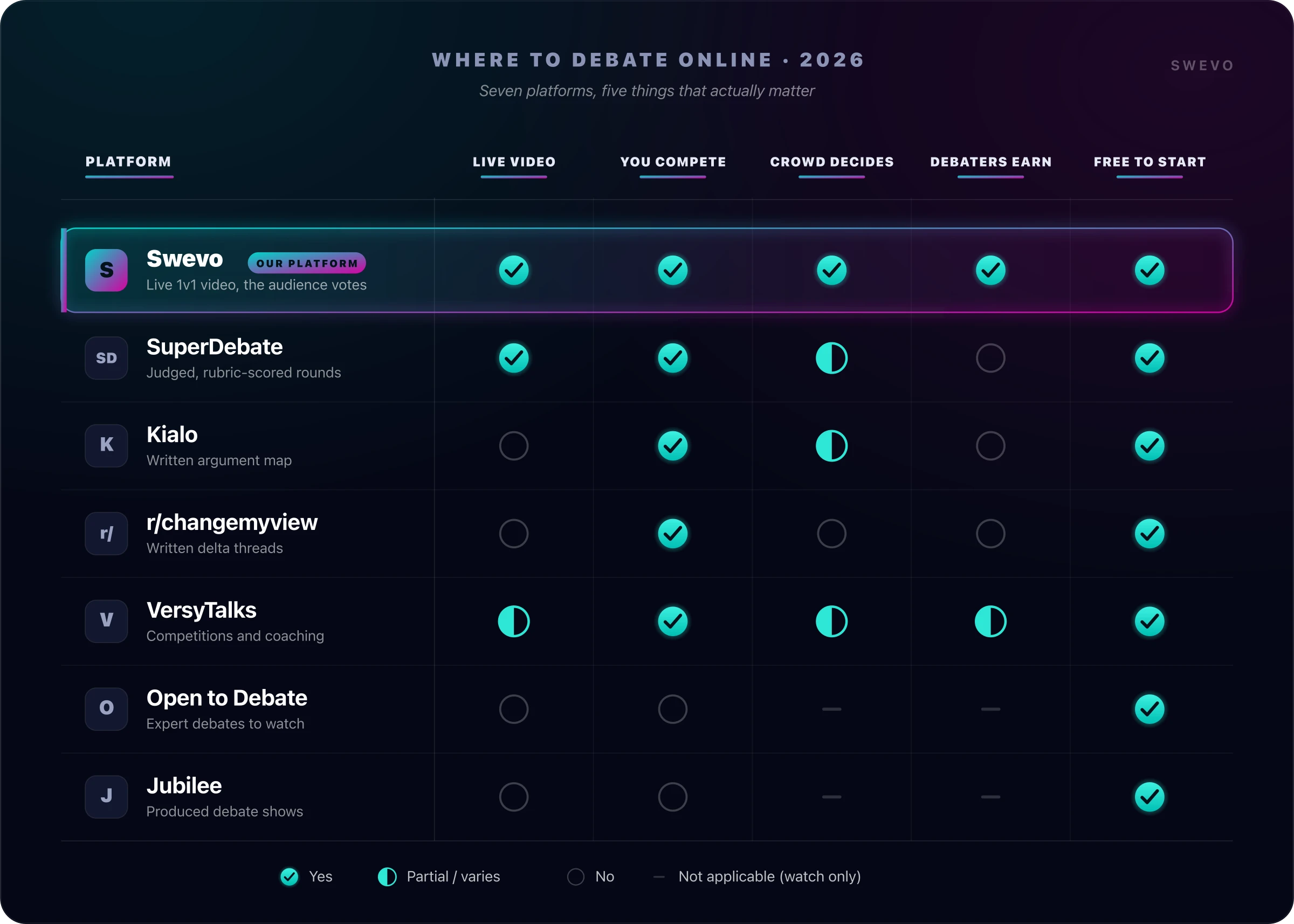
| Platform | Format | Who decides | Can debaters earn? | Cost to start | Best for |
|---|
| Swevo | Live video, 1v1 | The audience | Yes, 65% of tips and gifts | Free | Competing live and building an audience |
| SuperDebate | Live video rooms and events | Judges, plus optional audience vote | Not that we found | Free | Judged, rubric-scored practice |
| Kialo | Written argument map | Votes on individual claims | No | Free | Mapping both sides of a question |
| r/changemyview | Written threads | The original poster, by awarding deltas | No | Free | Testing a belief in writing |
| VersyTalks | Written and live | Varies by competition | Credits only | Free core features | Student competitions and coaching |
| Open to Debate | Watch only | Not applicable | Not applicable | Free to watch | Watching expert debates |
| Jubilee | Watch only | Not applicable | Not applicable | Free to watch | Watching high-energy shows |
AI is about to change how people practise. Most AI debate tools today are chat boxes: you type an argument, an AI types one back. SuperDebate's AI coach, Aurelius, works this way in its practice rounds, and it is a useful way to rehearse points.
But typing is not debating. The hard part of a live debate is speaking under pressure while someone looks at you and waits. That is why Swevo is building its AI sparring partner as a speaking video avatar rather than a text bot. You will argue with it out loud, face to face, on the same kind of screen you debate on, so practice feels like the arena. It is planned to launch before the end of 2026.
Paired with what is already live (real-time video, round-by-round audience voting, live chat and questions, and instant gifts that pay debaters), the aim is a platform where practising, competing, and getting paid all happen in one place.
You want to get better. Start with SuperDebate's judged rounds or VersyTalks' coaching, and use Kialo to research both sides of your topic. Before your first live round, read how to win a debate without raising your voice.
You want to compete and be seen. Go live. On Swevo, every round is judged by a real audience, and every good performance can grow your following and your earnings. Brush up on the logical fallacies opponents will use, then browse live and upcoming debates to see the format in action.
You want to learn by watching. Open to Debate and Jubilee are the best free shows around. When you catch yourself arguing back at the screen, that is your sign to take a turn yourself.
We checked every platform against its own website in October 2026, looking at format, how winners are decided, cost, and whether debaters can earn. Platforms that many older lists still recommend but that no longer appear to be operating were left out. Swevo is our own platform, so we have described the others as fairly as we can, using what they say about themselves.

 Featured